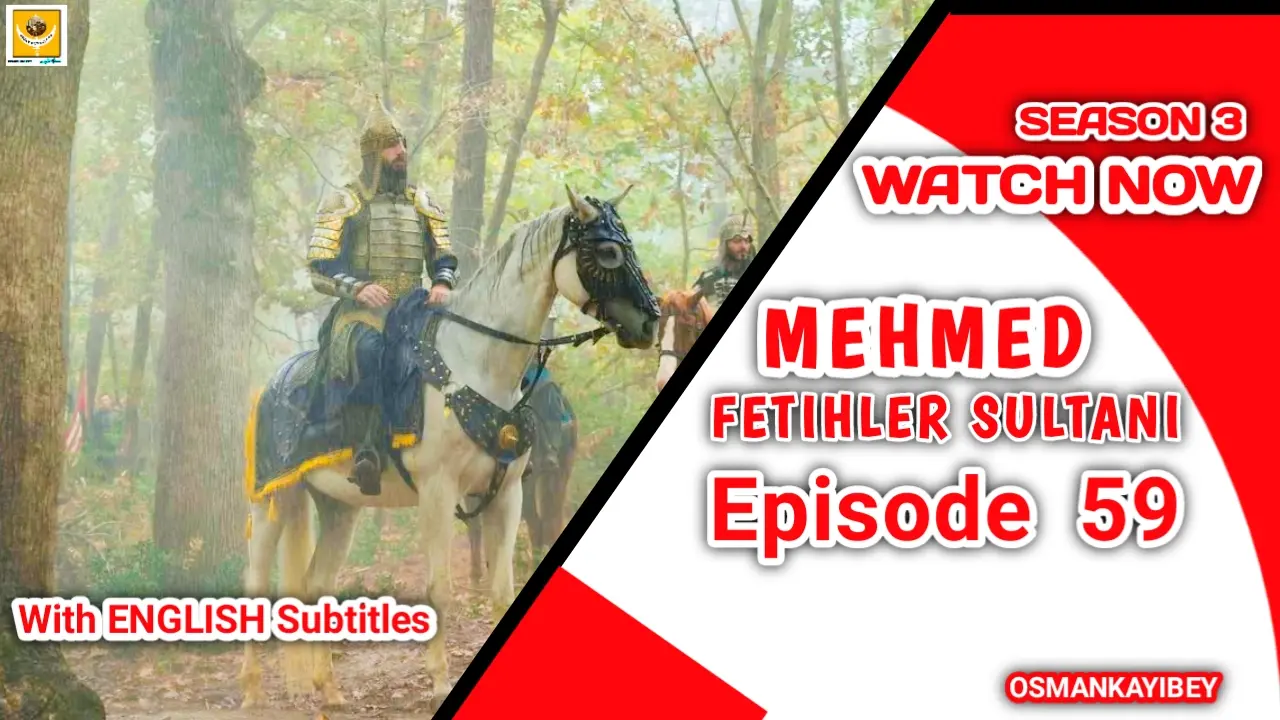
Mehmed Fetihler Sultani Season 3 Episode 59 With English Subtitles
The historical drama Mehmed: Fetihler Sultani continues to evolve into one of the most immersive portrayals of Ottoman imperial strategy, politics, and war. Season 3 Episode 59 stands out as one of the most emotionally charged and politically complex chapters so far. The episode not only addresses personal loss and fractured alliances but also the dramatic rise of external threats that seek to dismantle Mehmed’s vision of a unified realm.
Mehmed Fetihler Sultani Season 3 Episode 59 With English Subtitles
Episode 59 offers a larger-than-life narrative built on authentic historical foundations. Through sweeping landscapes, deeply layered character conflicts, and sharp political maneuvering, the series reconstructs the Ottoman world at a moment when its borders trembled, friendships dissolved, and enemies found new courage. Below is a complete, enriched, fully original analysis for your website—crafted for search engines and engaging enough for dedicated history enthusiasts.
The Shock of Loss: The Ottoman Front Reels from Zeynel’s Death
Episode 59 opens with an atmosphere thickened by grief. The loss of Zeynel—one of the most loyal faces of the Ottoman ranks—creates a violent ripple in the hearts of soldiers and commanders. This is not just the death of a warrior; it is the symbolic shattering of an emotional anchor in Mehmed’s growing empire.
Sultan Mehmed appears at the forefront of the mourning soldiers. His posture is solemn but unwavering. His voice, heavy yet controlled, delivers one of the most memorable lines of the season:
“We will not leave our blood on the ground.”
This line does more than promise vengeance. It revives the unspoken bond between the Sultan and his military household. In Ottoman military culture, discipline and emotional endurance were as important as swordsmanship. The army functioned not only through hierarchy but through a shared moral code. Mehmed’s speech reinforces this unity at a moment when fear and disillusionment could have spiraled into chaos.
SOURCE 1
The episode cleverly mirrors an important aspect of Ottoman leadership: a Sultan was expected to be both a father and a commander. Mehmed’s strength becomes the compass that re-aligns a shaken army.
SOURCE 2
Kurtçu and Bali Bey: From Internal Tension to Strategic Unity
The tension between Kurtçu and Bali Bey has brewed for several episodes. Their ideological divides and personal grievances threatened to fracture the army from within. Episode 59 brings this storm to its peak.
Their conflict reflects a historical truth: elite Ottoman commanders often represented competing regional interests, tribal loyalties, and military doctrines. These internal frictions were common during moments of major expansion.
SOURCE 3
I dedicate my time and effort to sharing Islamic history and the legacy of our heroes with the world. Your small donation helps me continue this mission. May Allah reward your support. 🤲
💖 Don’t be shy, even $3 makes a difference and helps keep this work going! ❤️
However, the episode takes a pivotal turn.
The looming Pontus threat forces the two proud warriors to recognize a greater danger. Their hostility dissolves into an uneasy, necessary coalition. The shift is symbolic. The Ottomans frequently harnessed internal diversity to overpower external enemies, turning rivalries into strategic strength.
This reconciliation builds the narrative foundation for the Ottoman response to Pontus: a front no longer distracted by infighting.
Pontus Rises: New Alliances, Old Hatreds, and a Brewing Storm
The episode transitions into the northern frontier, where tension grows like a storm gathering strength over the Black Sea. Pontus, long simmering with resentment against the Ottomans, senses an opportunity.
The narrative introduces three interconnected developments:
- Komnenos’s burning hatred reaches new levels.
- Uzun Hasan, leader of the Akkoyunlu, quietly signals his willingness to support Pontus.
- Diplomatic currents inside the palace grow uncertain.
The Komnenos dynasty, historically the final remnant of the Byzantine imperial line residing in the Trebizond region, is portrayed with emotional fire. Their resentment is not just political but deeply cultural. The series captures the lingering trauma of the fall of Constantinople, hinting at how regional rulers lived in the long shadow of Mehmed’s conquest.
Uzun Hasan’s potential alliance is especially significant. The Akkoyunlu Confederation was one of the most powerful military powers in the East, and their rivalry with the Ottomans shaped decades of regional warfare. His involvement raises the stakes dramatically. Pontus alone could irritate the empire; Pontus supported by Akkoyunlu could truly hurt it.
The palace scenes reinforce the fragility of political loyalty. Different voices, concerns, and hesitations echo through the Ottoman administration. Episode 59 subtly explores the heavy responsibility of governance—how even powerful states can be destabilized by conflicting visions, fear of war, and diplomatic miscalculations.
Beyazid and Mustafa in the Shadows of Danger
While the northern front trembles, the eastern frontier becomes increasingly volatile. Sultan Mehmed assigns his sons, Şehzade Beyazıd and Şehzade Mustafa, to oversee a critical defensive mission.
Their deployment symbolizes two important historical elements:
- Ottoman princes were trained not only in courtly arts but on active battlefields.
- The eastern frontier was the empire’s most dangerous geopolitical pressure point for many years.
The episode portrays the young princes embracing their responsibilities with both bravery and uncertainty. The rugged terrain, unpredictable weather, and invisible traps laid across the valleys amplify the sense of isolation. The soldiers under their command struggle against both nature and fear.
The show’s depiction of Eastern Anatolia’s geography is strikingly accurate. Mountain passes, deep ravines, and high plateaus made the region a natural fortress—and a strategic nightmare for armies.
Kadırga Plateau: Conflict, Discipline, and Mehmed’s Commanding Spirit
Episode 59 reaches one of its most intense internal conflicts when disputes erupt within the Ottoman ranks at Kadırga Plateau.
Arguments, exhaustion, and mistrust push the army toward a breaking point. Such moments were historically common during prolonged campaigns. Long marches and harsh landscapes often tested the psychological endurance of soldiers.
Sultan Mehmed steps into the heart of the turmoil. His entrance into the restless crowd feels like the arrival of a storm breaking upon the mountains. He does not reprimand them with cruelty; instead, he reminds them of who they are, why they fight, and what they represent.
This scene mirrors historical descriptions of Mehmed II’s leadership style. While stern and demanding, he understood the emotional pulse of his soldiers and commanded through a combination of charisma, pressure, and visionary rhetoric.
His speech rekindles morale and transforms the army’s despair into determination.
Yet the relief is temporary.
The true danger lies ahead—waiting in the shadowed paths of Gelevera Valley.
The Gelevera Valley Ambush: A Foreshadowing of Disaster
The episode ends with the looming threat of the Gelevera Valley, one of the most dramatic locations in the narrative. Historically known for its steep, forested slopes and deadly chokepoints, the valley was a place where armies could vanish without a trace.
The final scenes do not reveal the outcome but hint at the danger with meticulous storytelling. The wind grows louder, the air colder, and the soldiers sense something moving beyond the trees. Every rustle and shadow signals the possibility of death.
This cliffhanger prepares audiences for a major confrontation—one likely to change the course of the entire season.
Table: Key Political and Military Shifts in Episode 59
| Development | Impact on the Story |
|---|---|
| Death of Zeynel | Emotional fracture in the army |
| Alliance tensions resolved | Stronger front against Pontus |
| Komnenos’s rising aggression | Pontus becomes a serious enemy |
| Uzun Hasan’s involvement | Multi-front threat emerges |
Key Takeaways from Episode 59
- The episode blends personal tragedy with large-scale political danger, heightening emotional depth.
- Sultan Mehmed’s leadership remains central, shaping military discipline and strategic direction.
- Pontus emerges as a coordinated enemy with support from major regional powers.
- Internal unity becomes essential for the survival of the empire.
- The episode’s historical references enrich its authenticity.
- The narrative sets the stage for a major upcoming confrontation in Gelevera Valley.
Frequently Asked Questions
The episode highlights Zeynel’s death, rising Pontus threats, and Sultan Mehmed’s effort to restore unity.
Pontus under Komnenos and the Akkoyunlu influence of Uzun Hasan.
They are assigned to secure critical fortifications against growing eastern threats.
It is a dangerous terrain known for ambushes, setting the stage for the next major conflict.
Yes, it draws heavily from authentic Ottoman–Pontus–Akkoyunlu tensions of the period.
Conclusion
Mehmed Fetihler Sultani Season 3 Episode 59 is a powerful blend of emotional depth, strategic complexity, and cultural richness. It examines the fragility of unity within a growing empire while showcasing how external threats can force unlikely alliances. From the sorrow of Zeynel’s death to the impending danger in the Gelevera Valley, the episode builds a narrative that is both thrilling and historically layered.
The tension between old adversaries, the political ingenuity of Pontus, the looming alliance of Uzun Hasan, and the challenges faced by Ottoman princes create a sweeping story that resonates far beyond the battlefield. Episode 59 stands as a pivotal turning point in the season—one that promises even greater confrontations and deeper emotional stakes in the chapters ahead.